WS RDS vs Self-Hosted PostgreSQL: Complete Cost Comparison (2026)
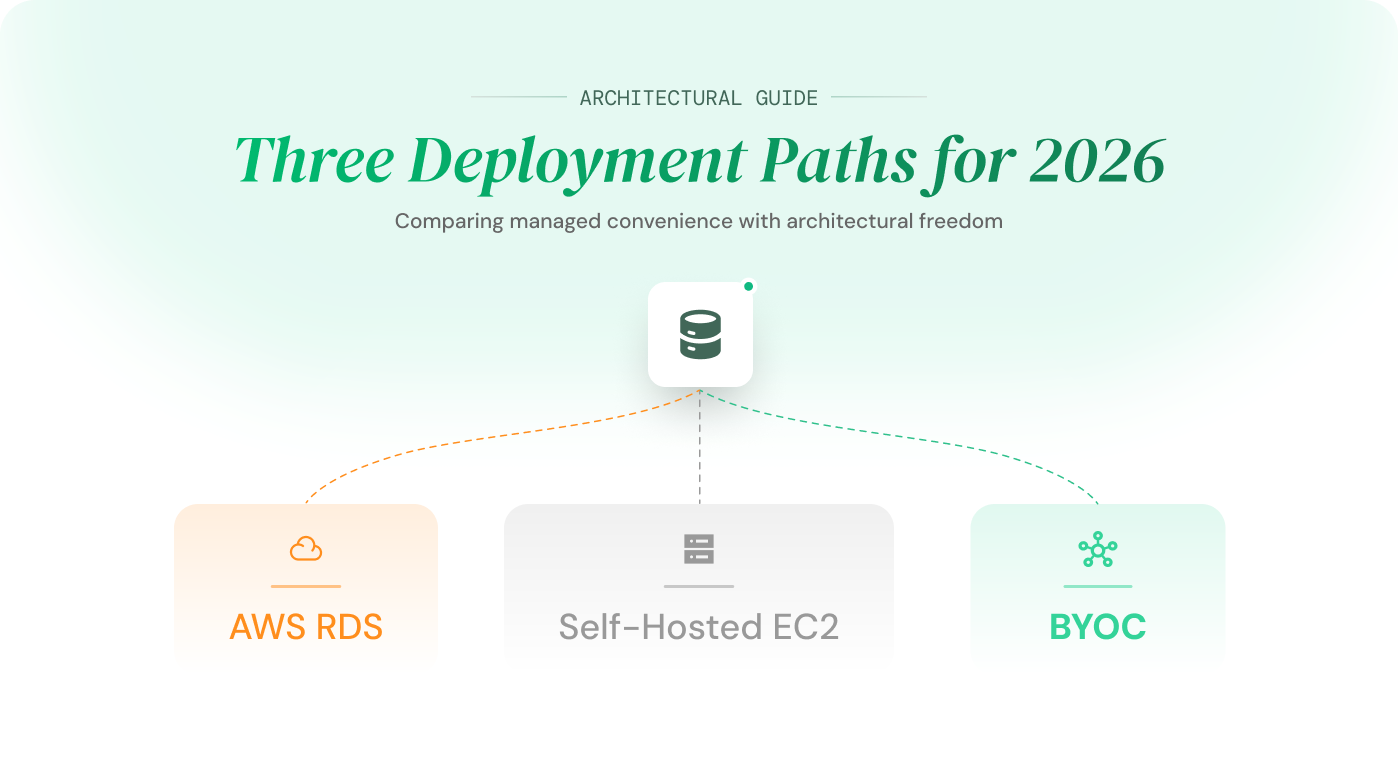
The AWS RDS vs self-hosted PostgreSQL debate usually starts the same way. Someone opens the cloud bill, pauses, and asks: are we really paying this much just for a database?
According to Flexera’s 2026 State of the Cloud Report, 29% of cloud spend is currently wasted, and managing cloud costs remains the top challenge for 85% of organisations. Database infrastructure, particularly RDS, is one of the most consistent contributors to that figure.
If you are here, you are likely evaluating whether AWS RDS is still the right choice for your PostgreSQL workload, or whether self-hosting on EC2 would save you money. Most guides present this as a binary decision. It isn’t.
Most teams frame this as managed vs self-hosted, but the reality is more nuanced.
If you’re evaluating that trade-off, start here: Managed vs Self-Hosted Database: Which Is Better for Your Startup?
This article compares three models for running PostgreSQL in 2026: AWS RDS (fully managed), self-hosted on EC2, and BYOC (Bring Your Own Cloud). Each section includes verified pricing so you can see the real cost difference, not estimates.
AWS RDS vs Self-Hosted PostgreSQL
If you’re comparing AWS RDS vs self-hosted PostgreSQL, here’s the real cost difference in 2026:
– AWS RDS: ~$744/month (fully managed, Multi-AZ, replica, backups)
– Self-hosted on EC2: ~$332/month infrastructure (~$832+ with engineering time)
– BYOC (Bring Your Own Cloud): ~$300–$400/month with managed operations
Self-hosted PostgreSQL looks cheaper on paper, but often becomes more expensive than RDS once operational effort is included. BYOC offers the lowest total cost with managed reliability.
Why Teams Are Moving From AWS RDS to Self-Hosted PostgreSQL
AWS RDS is the default choice for teams that want a managed PostgreSQL database without thinking about infrastructure. AWS handles provisioning, automated backups, patching, and failover. For an early-stage product, that trade-off makes sense. You pay more per dollar of compute, but your engineers spend zero time on database operations.
The shift in thinking happens when the product matures and the architecture grows to match.
Here is what typically changes:
- Multi-AZ gets enabled for production reliability. This alone doubles your compute cost because AWS bills the standby instance at the same rate as the primary.
- A read replica gets added for query performance. That is another full-price instance.
- A staging environment is created to mirror production. Another instance, another storage volume.
- Backup retention increases from 7 days to 35 days as compliance requirements tighten. Storage charges grow accordingly.
- IOPS requirements increase as write-heavy workloads scale. Provisioned IOPS on io1 are billed separately at $0.10 per IOPS per month.
None of these changes are wasteful. Every one of them exists because the product genuinely needs it. But each is a separate billing layer, and together they explain why a PostgreSQL database that cost $138/month at launch quietly becomes $744/month without a single line of application code changing.
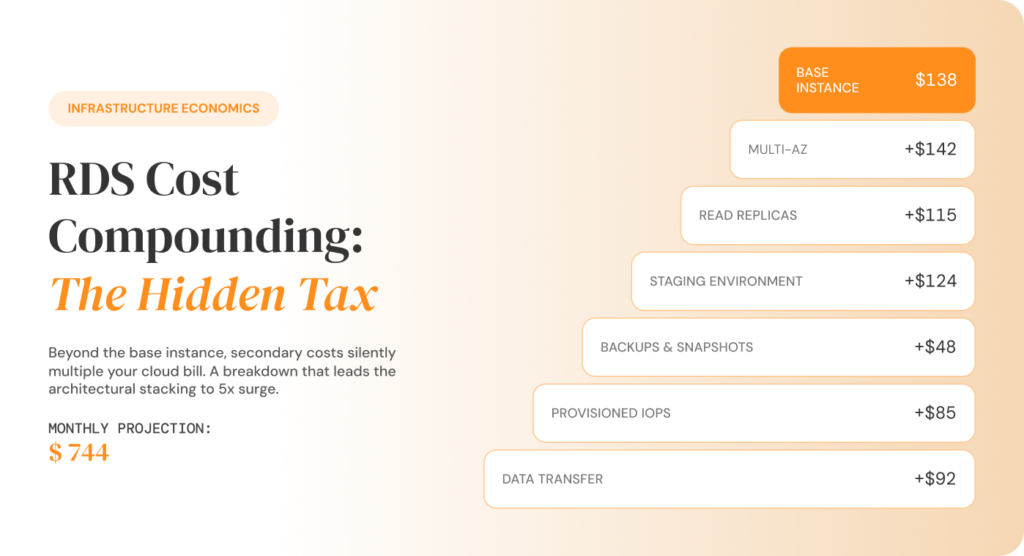
This is documented in detail in Why AWS RDS Is Expensive Once Your Product Starts Growing, which walks through each cost layer with verified 2026 AWS pricing.
When teams reach this point, the question is no longer “How do I optimise this RDS bill?” The optimisation ceiling is real: if your system genuinely requires Multi-AZ, a read replica, a staging environment, and reliable backups, those are structural costs. No amount of right-sizing or reserved instance purchasing will make them disappear.
The real question becomes: is the managed service model still the right model for where my product is today?
If your RDS bill is already crossing $500/month, this is typically the point where that question becomes financially significant.
At this stage, many teams also start comparing alternatives directly such as:
SelfHost vs AWS RDS (full comparison)
That question is what drives the AWS RDS vs self-hosted PostgreSQL comparison. But as you will see in the next section, managed and self-hosted are not the only two options available in 2026.
Three Ways to Run PostgreSQL in 2026: RDS vs EC2 vs BYOC
Every guide comparing RDS vs EC2 for PostgreSQL presents two options: pay AWS to manage it, or manage it yourself. That framing made sense five years ago. It doesn’t in 2026.
There are now three distinct models for running PostgreSQL in production. Each has a different cost structure, a different operational profile, and a different set of trade-offs.
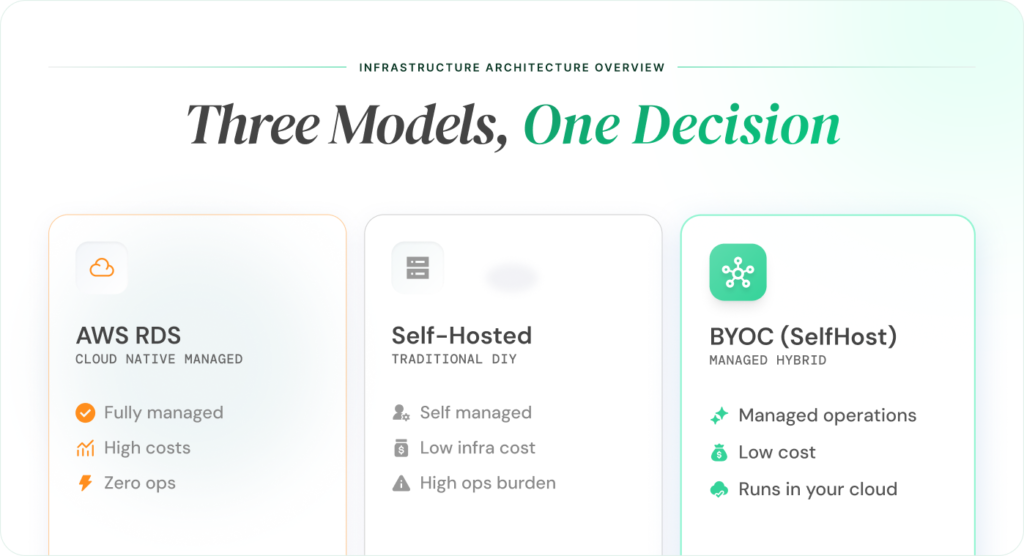
Managed: AWS RDS
AWS provisions and operates your PostgreSQL database. You select an instance size, choose a storage type, and AWS handles patching, backups, replication, monitoring, and failover.
The convenience is real. So is the markup. You are paying a managed service premium on every component, compute, storage, IOPS, backups, and data transfer, all billed independently. As your architecture adds Multi-AZ, read replicas, and staging environments, those premiums compound across every layer.
RDS is the right model when your database bill is small and your team’s time is more valuable than the cost difference. It stops being the right model when the bill grows and the premium scales with it.
Self-Hosted: PostgreSQL on EC2
You install and run PostgreSQL directly on EC2 instances. You pay raw AWS compute and storage rates, no managed service layer on top.
Infrastructure costs drop 40–60% compared to RDS for the same workload. But the AWS bill is only part of the cost. You now own every operational responsibility:
- High availability: Patroni or similar for automated failover
- Backups: pgBackRest with S3 integration, compression, encryption
- Monitoring: Prometheus, Grafana, alerting rules, on-call rotation
- Upgrades: PostgreSQL minor and major version patching
- Security: OS hardening, network configuration, access controls
For teams with a dedicated infrastructure engineer or DBA, this trade-off can work. For teams without one, self-hosting shifts the cost from the AWS bill to engineering time, which is often more expensive.
BYOC: Bring Your Own Cloud
Your PostgreSQL database runs inside your own cloud account, your AWS, your GCP, your Azure. You pay the cloud provider directly at standard compute and storage rates, the same rates as self-hosted. No managed service markup sits on top.
A platform handles the operational layer: provisioning, failover, backups, monitoring, upgrades, and scaling. Platforms like SelfHost handle this operational layer while your database continues to run inside your own cloud account. You get the cost structure of self-hosted with the operational simplicity of managed.
To see how these trade-offs play out in real-world platforms, explore these direct comparisons:
These comparisons break down cost, control, and operational complexity across different database platforms.
Platforms like SelfHost handle the operational layer while your database continues to run inside your own cloud account, giving you the cost structure of self-hosted with the simplicity of managed services.
To understand how this model works in detail, see:
What Is BYOC? A Smarter Alternative to Expensive Managed Databases
The key difference from RDS: you are not paying a premium on every GB and every instance hour.
The key difference from self-hosted: you are not staffing a team to keep the database running.
RDS vs EC2 Database Cost: The Same Workload, Three Price Tags
Comparisons without numbers are opinions. This section prices the exact same PostgreSQL workload across all three models using verified 2026 AWS pricing for us-east-1 (N. Virginia), cross-referenced against the AWS official RDS pricing page and Vantage EC2 Instances.
The workload: a production-grade PostgreSQL setup on db.m6g.large (2 vCPU, 8 GB RAM) with high availability, one read replica, a staging environment, and 500 GB of gp3 storage. This is the same configuration used in Why AWS RDS Is Expensive Once Your Product Starts Growing so you can compare directly.
How Much Does AWS RDS Cost Per Month? (Real Breakdown)
| Component | Detail | Est. Monthly Cost |
|---|---|---|
| Production (Multi-AZ) | db.m6g.large, $0.318/hr on-demand | ~$232 |
| Read replica | db.m6g.large, $0.159/hr | ~$116 |
| Staging (Single-AZ) | db.m6g.large, $0.159/hr | ~$116 |
| Storage (gp3) | 500 GB prod + 200 GB staging, $0.115/GB-month | ~$80 |
| Backup storage | 35-day retention, $0.095/GB-month beyond free tier | ~$45 |
| Provisioned IOPS | io1, 1,000 IOPS at $0.10/IOPS-month | ~$100 |
| Data transfer | Cross-AZ sync, replica traffic, outbound | ~$55 |
| Total | ~$744/month |