

Why Secure PostgreSQL Hosting for SaaS Became a Critical Decision for a Solo Founder
Secure PostgreSQL hosting for SaaS became a critical decision for this solo founder because early infrastructure choices directly affected security, cost predictability, and long-term scalability. In this case study, we explore how evaluating SelfHost helped the founder build production-ready PostgreSQL infrastructure, avoid vendor lock-in risk, and establish cloud database security before public launch.
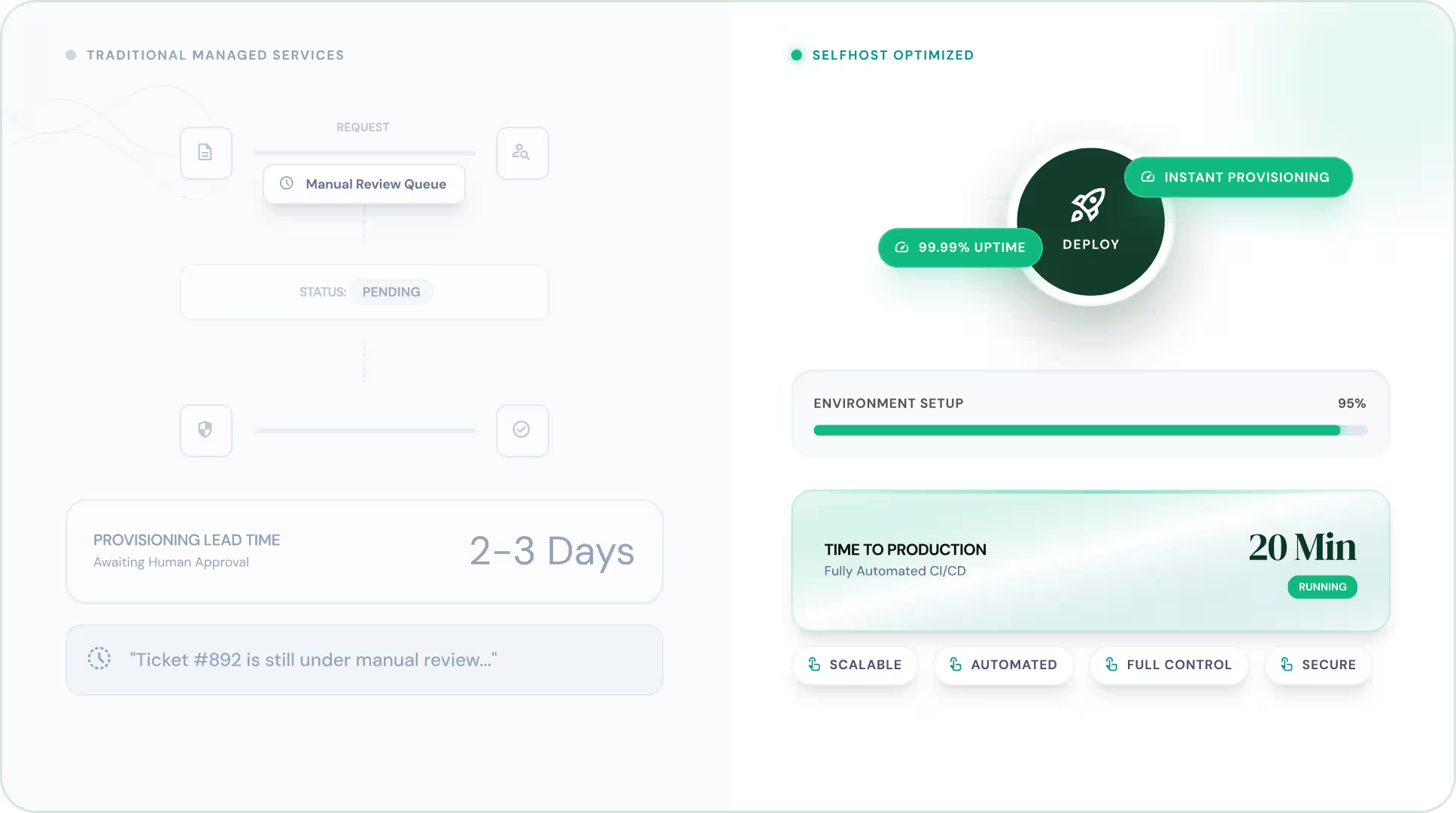
The Situation
A solo founder was building a B2B SaaS platform focused on analytics automation for mid-sized businesses. What began as a side project quickly evolved into a promising startup.
Within months:
- Beta users were active frequently
- Trial accounts were converting
- Enterprise prospects were requesting demos
The product was database-heavy. Every workflow depended on PostgreSQL performance, availability, and reliability.
At this stage, the founder began evaluating secure PostgreSQL hosting for SaaS that could support both early traction and long-term growth. This wasn’t just about choosing a hosting provider. It was about selecting PostgreSQL hosting for startups that could provide predictable scaling and production stability.
They needed a production-ready PostgreSQL infrastructure before public launch.
The core question became:
Should they rely on a managed database service like Amazon RDS, or move toward a self-hosted PostgreSQL setup?
Should they rely on a managed database service like Amazon RDS, or move toward a self-hosted PostgreSQL setup?
They evaluated platforms under Amazon Web Services and Google Cloud, focusing on managed PostgreSQL services such as Amazon RDS. At first glance, managed services seemed like the safest route.
But deeper evaluation revealed concerns around predictability, infrastructure ownership, and long-term architectural control. This was not simply a hosting choice.
It was a foundational decision that would shape the startup’s future.
The Problem: Why Secure PostgreSQL Hosting for SaaS Matters Before Launch
Unlike many early-stage startups, this founder’s primary concern was not only reducing cost. It was building a scalable and secure PostgreSQL hosting foundation that would support compliance, enterprise trust, and operational clarity.
Three major challenges became clear:
1. Cost Predictability in Early-Stage SaaS
Managed PostgreSQL services like Amazon RDS offer convenience, but pricing structures are layered and complex.
The founder noticed:
- Instance-based pricing that escalated quickly
- Storage costs increasing unpredictably
- Backup retention fees
- High availability configurations doubling costs
- IOPS-based billing fluctuations
Even a modest production setup could reach $300–$500 per month.
For a solo founder operating on personal savings and early revenue, this created runway risk. They weren’t just evaluating monthly spend. They were evaluating predictable cloud database costs.
In early-stage SaaS, financial visibility is strategic.
Founders in similar situations often explore how to reduce AWS RDS costs before scaling further.
2. Limited Infrastructure Control
Enterprise clients were beginning to ask security-related questions:
- Where is the data hosted?
- How are backups encrypted?
- What is the disaster recovery model?
- Can configurations be customised?
Managed services abstract infrastructure layers. While convenient, that abstraction limited:
Under the AWS Shared Responsibility Model, infrastructure ownership is divided between the provider and the customer, which can limit visibility into deeper security controls.
- Low-level configuration tuning
- Network level granularity
- Advanced PostgreSQL optimisation
- Visibility into backup processes
The founder recognised a deeper issue: enterprise clients expect strong cloud database security for SaaS platforms.
To build trust wih B2B clients, they needed deeper ownership of their infrastructure.
They began researching:
- Secure self-hosted PostgreSQL
- Compliant cloud database infrastructure
- AWS RDS alternative for startups
- Vendor lock-in risk in cloud databases
This wasn’t about avoiding managed services entirely. It was about avoiding strategic dependency.
3. Long-Term Vendor Lock-In Risk
Early infrastructure decisions often become permanent. If the startup scaled on a managed database ecosystem:
- Migration later would be complex
- Data transfer costs could be significant
- Architecture decisions would be cloud-constrained
- Negotiating pricing leverage would diminish
Vendor lock-in wasn’t theoretical, it was strategic risk.
The founder wanted a cloud-agnostic PostgreSQL hosting approach from day one.
However, fully manual deployment meant:
- Writing custom backup scripts
- Configuring replication manually
- Managing failover workflows
- Setting up monitoring tools
- Ensuring patching and updates
They needed something in between:
The control of self-hosted PostgreSQL infrastructure, The reliability of managed services, And the affordability required for early-stage SaaS.
The Opportunity: A Structured Approach with SelfHost
Instead of choosing between expensive managed PostgreSQL hosting and fragile manual deployment, SelfHost provided a third path.
A structured, scalable approach to secure PostgreSQL hosting for SaaS, designed specifically for startups.
SelfHost allowes the founder to:
- Deploy PostgreSQL on right-sized compute
- Avoid managed service premiums
- Pay for raw infrastructure instead of platform markup
- Forecast infrastructure spend with clarity
This model supports early-stage founders looking for a cost-efficient managed database platform while retaining infrastructure ownership.
Instead of opaque billing tied to bundled metrics, costs aligned directly with compute and storage usage. This improved startup runway forecasting and financial planning.
SelfHost also delivered:
- Automated encrypted PostgreSQL backups
- Structured PostgreSQL high availability setup
- Standardised configuration templates
- Centralised monitoring visibility
- Defined disaster recovery workflows
This eliminated manual scripting while preserving architectural independence.
In effect, it functioned as an AWS RDS alternative tailored for startup control and compliance.
For founders thinking long term, this also aligns with broader multi-cloud database management strategies that reduce ecosystem dependency.
The founder gained:
- Secure infrastructure
- Disaster recovery readiness
- Predictable cloud database costs
- Reduced operational anxiety
All without hiring a DevOps engineer.
Expected Business Impact
If implemented before launch, the founder could achieve:
- 40–50% lower database costs
- Reliable backups without complex scripting
- Clear infrastructure cost visibility
- Faster go-to-market without operational distraction
- Reduced compliance risk
Strategic Outcomes
SelfHost provides a balanced, strategic solution by providing:
- Secure, production-ready infrastructure
- Predictable cloud database costs
- Reduced vendor dependency
- Scalable foundation for growth
For solo founders building B2B products, secure PostgreSQL hosting is not a technical luxury. It is a trust signal.
Strong cloud database security for SaaS builds credibility with enterprise buyers, protects runway, and enables confident scaling.
Early infrastructure decisions compound.
Choosing secure PostgreSQL hosting for SaaS from day one reduces long-term risk while preserving control, compliance, and flexibility.
Potential Results with SelfHost
Metric
Monthly Database Cost
Setup Time
Operational Complexity
Scalability Readiness
Before
~$280/month
2–3 days
High overhead
Limited scaling
After
~$45/month
20-30 minutes
Minimal effort
Production ready
What our users say
"Nextsaas delivered our entire platform ahead of schedule—flawless execution and real partnership."

"SelfHost is the first database tool where I didn't need to bug our infrastructure team every other day. Spun up a production database for our ML pipeline in literally 3 minutes. The real-time metrics are actually useful, I can see when my batch jobs are hammering the database and adjust accordingly."
Madhav Dhadwal
Data Scientist Extraordinaire at Tailwyndz LLC
Run Production Databases
On Your Terms
Deploy self-hosted PostgreSQL and scalable cloud databases with automation, high availability, and full infrastructure control.
- No credit card required
- Join waitlist today