

How a Bootstrapped SaaS Startup Learned to Reduce AWS RDS Costs by 50% Without Sacrificing Performance
Two technical founders launched a developer-focused SaaS platform that automated API workflows.
What started as a side project quickly gained traction within engineering communities. Within six months, monthly active users tripled, API request volume increased fivefold, and paid conversions steadily improved.
But as infrastructure scaled, margins began tightening. What initially felt like a hosting decision became a financial one. They realised they needed to reduce AWS RDS costs without compromising PostgreSQL performance, reliability, or long-term scalability.
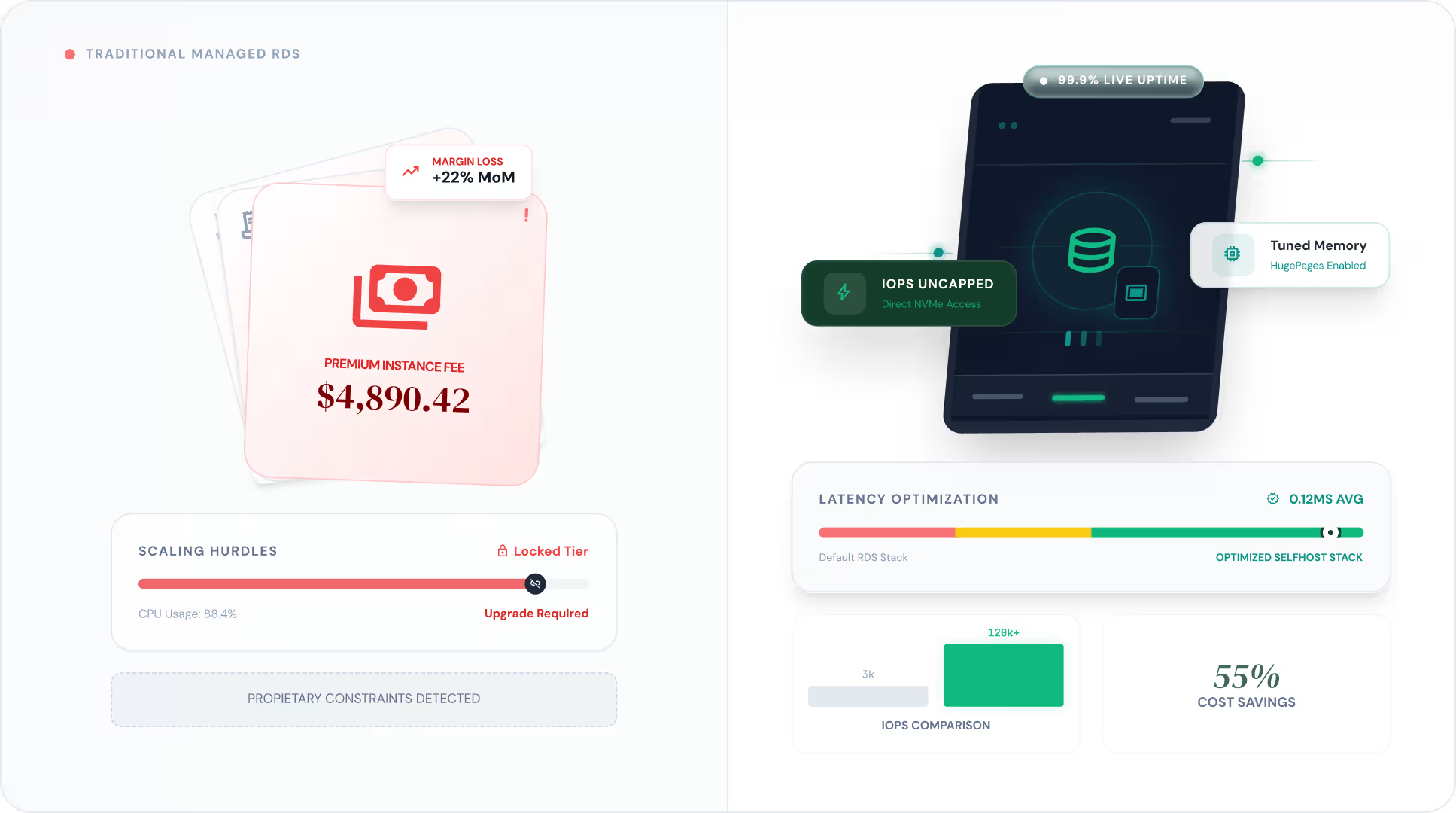
The Challenge - Why It Became Critical to Reduce AWS RDS Costs
In the early stages, deploying PostgreSQL through Amazon RDS under Amazon Web Services provided operational simplicity. For low traffic workloads, it worked well.
However, as usage increased, three structural challenges emerged.
Escalating RDS Pricing Tiers
Under managed services, scaling performance typically requires upgrading instance classes. When they needed more CPU, higher IOPS, or better memory allocation, the only option was moving to significantly more expensive RDS pricing tiers. Each upgrade meant:
- 40–70% jumps in monthly database cost
- Paying for bundled CPU, RAM, and storage they didn’t fully utilise
- Limited flexibility for granular AWS RDS cost optimisation
Instead of scaling incrementally, they were forced into bundled instance upgrades. What they needed wasn’t a bigger tier, it was smarter resource allocation.
Limited PostgreSQL Performance Control
As engineers, they wanted deep PostgreSQL performance tuning:
- List Item Custom memory configuration#1
- Vacuum and autovacuum adjustments
- Advanced indexing strategies
- Query-level optimisation
But managed services abstracted many of these controls. Certain low-level configurations were restricted or discouraged. For a developer-first SaaS startup, performance tuning was a competitive advantage. Yet their current setup limited experimentation and fine-grained optimisation.
Inefficient Scaling Model
RDS-style scaling introduced additional inefficiencies:
- Bundled vertical scaling
- Increased Multi-AZ replication charges
- Higher backup storage costs
- Paying for unused compute capacity
They recognised something critical: Their database wasn’t underpowered. It was misaligned with workload needs.
What they required was a right-sized PostgreSQL deployment, not forced enterprise tiers.
The Hidden Limitations of RDS Pricing Tiers
Traditional managed services prioritise convenience over control. While they reduce operational overhead, they also reduce flexibility.
For bootstrapped SaaS teams, this creates a cycle: Higher traffic → Higher RDS tier → Higher cost → Margin pressure
At this stage, the conversation shifted toward exploring an AWS RDS alternative that allowed deeper infrastructure optimisation without sacrificing reliability.
They weren’t trying to abandon managed automation. They were searching for a smarter balance between control and convenience.
A Smarter Alternative: Performance-Focused PostgreSQL Infrastructure
By adopting SelfHost, the team could transition from rigid managed tiers to a flexible, performance-driven architecture.
Instead of paying bundled premiums, they could deploy a PostgreSQL hosting alternative to RDS built around precision scaling and workload alignment.
With SelfHost, they could:
- Deploy PostgreSQL on right-sized compute instances
- Optimise CPU, RAM, and disk I/O at the infrastructure level
- Tune memory allocation and caching strategies
- Scale vertically or horizontally with intention
This enabled true AWS RDS cost optimisation rather than reactive tier upgrades. By combining infrastructure tuning with controlled scaling, they achieved:
- Better performance per dollar
- Lower cost per API request
- Reduced infrastructure waste
For early-stage teams, this shift transformed cost spikes into predictable engineering decisions.
Instead of escalating enterprise pricing, they adopted cost-efficient database hosting that aligned with actual workload demand.
At the same time, they benefited from high-performance PostgreSQL hosting capabilities, maintaining full configuration access while preserving automation.
This model delivered the flexibility of self-hosted PostgreSQL infrastructure without the operational burden traditionally associated with manual database management.
Business Impact- Lower Costs, Higher Performance
Within months of shifting architecture:
- Database infrastructure costs reduced by 35–55%
- Query latency improved during peak load
- Cost per active user decreased
- Deployment cycles accelerated
By moving away from rigid managed tiers and embracing a more scalable database architecture for startups, they built infrastructure that grew sustainably with demand. This transition didn’t just reduce SaaS infrastructure costs, it strengthened margin predictability and long-term operational stability.
Strategic Outcomes for Bootstrapped SaaS Teams
By exploring a modern AWS RDS alternative, the startup achieved:
- Greater engineering autonomy
- Predictable infrastructure spending
- Advanced PostgreSQL performance tuning capabilities
- Reduced dependence on expensive managed services
This case mirrors a broader pattern seen in organisations seeking to reduce managed database costs across multi-cloud environments while maintaining operational resilience.
For bootstrapped SaaS founders, infrastructure decisions directly influence runway. The ability to reduce AWS RDS costs sustainably, while improving performance, creates a durable competitive advantage.
Expected Business Impact
Within months of switching:
- Database infrastructure costs reduced by 35–55%
- Query latency improved during peak load
- Cost per active user decreased
- Feature deployment cycles accelerated
Strategic Outcomes
By adopting SelfHost, they can achieve:
- High-performance database infrastructure
- Cost-efficient scaling
- Reduced reliance on expensive managed services
- Greater engineering control
Potential Results with SelfHost
Metric
Infrastructure Speed
Deployment Speed
Maintenance Effort
Profit Margin Impact
Before (Managed RDS Setup)
Performance bottlenecks
Slow release cycles
Manual tuning & monitoring
Rising infrastructure costs
After (With SelfHost)
Optimized workload execution
Rapid, controlled deploys
Automated workflows
Improved margins
Conclusion
Managed services like Amazon RDS simplify early infrastructure decisions, but as SaaS platforms scale, bundled pricing tiers can erode margins.
This case study demonstrates that teams do not always need larger instances, they need smarter architecture. By shifting to a performance-focused model and embracing a flexible PostgreSQL hosting alternative, startups can reduce AWS RDS costs while preserving speed, control, and scalability.
In early-stage SaaS, those savings compound.
What our users say
"Nextsaas delivered our entire platform ahead of schedule—flawless execution and real partnership."

"I've spent years writing Terraform scripts and debugging CloudFormation templates just to get databases running properly. SelfHost basically replaced two weeks of implementation work with a 10-minute setup. The Multi-AZ configuration that used to take me days of testing just... works out of the box."
Atik Sharma
Senior Implementation Analyst at FIS
Run Production Databases
On Your Terms
Deploy self-hosted PostgreSQL and scalable cloud databases with automation, high availability, and full infrastructure control.
- No credit card required
- Join waitlist today