
Proven Ways to Reduce AWS RDS Costs for SaaS Platforms By 50%
2 technical co-founders
Pre-seed / Bootstrapped. MVP Live.
~1,200 early users. Revenue just starting
The Situation
Two technical founders built a developer-focused SaaS product that automated API workflows. What started as a side project quickly gained traction within engineering communities. Within six months:
- Monthly active users tripled
- API request volume increased 5x
- Paid conversions steadily improved
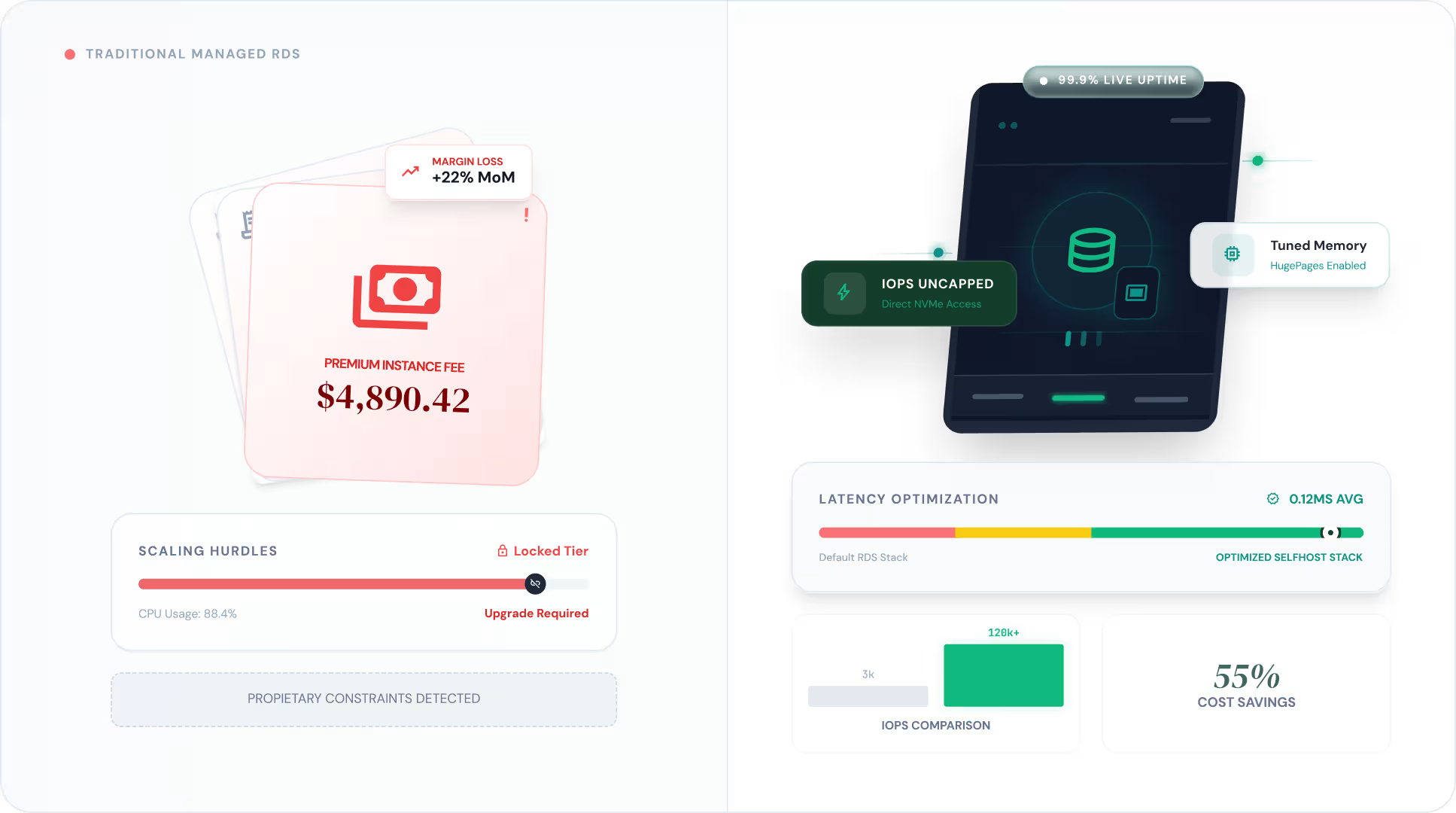
Their product relied heavily on PostgreSQL for transactional workloads, background jobs, and reporting queries. In the early days, they chose convenience and deployed PostgreSQL through Amazon RDS under Amazon Web Services. At low traffic, this worked perfectly, but as usage scaled, performance bottlenecks began surfacing. Slow queries. Higher latency during peak hours. Escalating instance costs.
This was no longer just a hosting decision. It was a profit margin decision, and the core question became, how do we reduce AWS RDS cost for Saas platform of ours?
The Problem
As their SaaS product matured, three critical infrastructure challenges emerged. Under managed database services, performance scaling typically requires upgrading instance tiers. When they needed more CPU, higher IOPS, and better memory allocation, and the only option was moving to a significantly more expensive tier.
Each upgrade meant a 40–70% jump in monthly database cost, paying for bundled resources they didn’t fully use, and limited granular optimisation. Instead of scaling incrementally, they were forced into aggressive pricing tiers.
Managed database services simplify operations but restrict deep configuration control. As engineers, they wanted to tune PostgreSQL parameters, optimise memory allocation, adjust vacuum settings, implement advanced indexing strategies and experiment with query optimisation. But these managed services abstracted much of that control.
Certain low-level configurations were restricted or discouraged. For a developer-centric SaaS company, this was frustrating. They needed high-performance PostgreSQL hosting, full configuration control, infrastructure-level optimisation, self-hosted like database flexibility. Performance tuning is a competitive advantage in SaaS, and they felt constrained.
Also under RDS-style scaling, upgrades meant:
- Bundled CPU, RAM, and storage increases
- Paying for unused capacity
- Higher backup costs
- Increased multi-AZ replication charges
They noticed something important, their database wasn’t underpowered, it was poorly optimised for their workload. They didn’t need a bigger database, they needed a smarter one. Here they should shift their search towards right-sized PostgreSQL infrastructure, self-hosted like database for performance optimisation, and scalable database architecture for startups.
With SelfHost:
SelfHost positions itself as a high-performance PostgreSQL hosting alternative to AWS RDS and introduces a fundamentally different approach. Instead of upgrading into expensive managed tiers, they could:
- Deploy PostgreSQL on right-sized compute
- Tune configurations at the infrastructure level
- Scale vertically or horizontally with precision
- Maintain cost-efficient database hosting
With Selfhost, they can gain full PostgreSQL configuration access, custom memory tuning, advanced indexing and caching strategies and query-level performance experimentation.
Instead of relying on bundled instance upgrades, they can optimise CPU allocation, RAM utilisation, and disk I/O efficiency. This delivers performance improvements without immediate cost escalation.
Rather than jumping tiers, they could increase compute incrementally, optimise workloads before upgrading, separate read replicas strategically snd introduce high availability when justified. This transforms scaling from a pricing shock into a controlled engineering decision.
By combining infrastructure tuning with controlled scaling, they can achieve better performance per dollar, lower cost per API request and reduced infrastructure waste. Instead of paying enterprise-level managed database premiums, they can operate on efficient PostgreSQL infrastructure architecture.
Expected Business Impact
Within months of switching:
- Database infrastructure costs reduced by 35–55%
- Query latency improved during peak load
- Cost per active user decreased
- Feature deployment cycles accelerated
Strategic Outcomes
By adopting SelfHost, they can achieve:
- High-performance database infrastructure
- Cost-efficient scaling
- Reduced reliance on expensive managed services
- Greater engineering control
Potential Results with SelfHost
Metric
Infrastructure Spend
Deployment Speed
Maintenance Effort
Profit Margin Impact
Before
Rising costs
Slow releases
Manual management
Reduced margins
After
Controlled spend
Rapid deploys
Automated workflows
Improved margins
What our users say
"Nextsaas delivered our entire platform ahead of schedule—flawless execution and real partnership."

"I've spent years writing Terraform scripts and debugging CloudFormation templates just to get databases running properly. SelfHost basically replaced two weeks of implementation work with a 10-minute setup. The Multi-AZ configuration that used to take me days of testing just... works out of the box."
Atik Sharma
Senior Implementation Analyst at FIS
Run Production Databases
On Your Terms
Deploy self-hosted PostgreSQL and scalable cloud databases with automation, high availability, and full infrastructure control.
- No credit card required
- Join waitlist today